
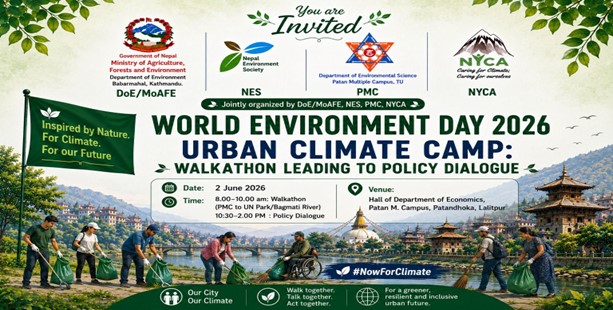
Fig: Official banner of the World Environment Day 2026 – Urban Climate Camp: Walkathon Leading to Policy Dialogue
On the occasion of World Environment Day 2026, an “Urban Climate Camp and Policy Dialogue” was organized on 2 June 2026 at Patan Multiple Campus, Lalitpur, under the theme “Inspired by Nature; For Climate, For Our Future.” The event was jointly organized by Nepal Environment Society (NES), Department of Environment (DoE), Ministry of Agriculture, Forests and Environment (MoAFE), Department of Environmental Science, Patan Multiple Campus (TU), and Nepalese Youth for Climate Action (NYCA). The event brought together government officials, academicians, researchers, environmental professionals, students, youth leaders, and development practitioners to discuss urban climate challenges, river conservation, and pathways toward sustainable and climate-resilient cities in Nepal.
The celebration commenced with a climate-awareness walkathon and environmental campaign involving students, teachers, youth activists, and environmental professionals. The walkathon began from Patan Multiple Campus and proceeded through UN Park to the Bagmati River Corridor, promoting public awareness on river conservation, urban environmental management, and climate action. Students actively participated in environmental awareness activities through poster displays, environmental messages, and creative demonstrations highlighting the importance of protecting nature and combating climate change. Their enthusiastic participation reflected the growing commitment of Nepalese youth toward environmental stewardship and sustainable development.
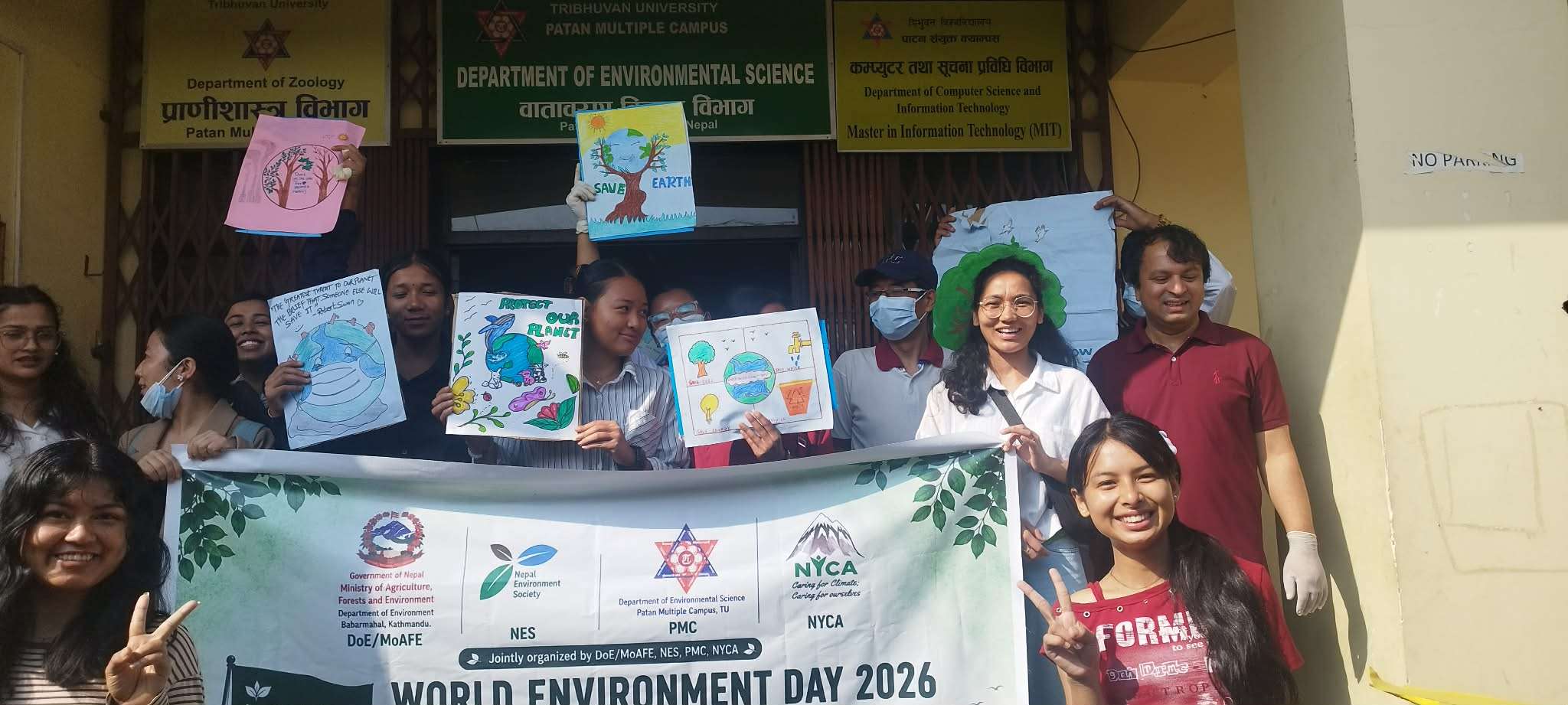
Fig: Students participating in environmental awareness activities and displaying climate action messages.
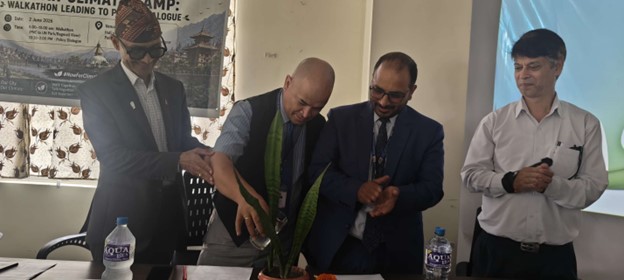
Fig: Formal inauguration of the World Environment Day 2026 program by distinguished guests
During inaugural session, the formal program was chaired by Dr. Raghuveer Bista, Campus Chief of Patan Multiple Campus. Dr. Ram Chandra Kandel, Joint Secretary of the Ministry of Agriculture, Forests and Environment, attended as the Chief Guest, Mr. Saroj Kumar Chaudhary, DDG, DoE/MOAFE as the Special Guests, Distinguished guests from Policy Research Institute, Water and Energy Commission Secretariat, National Planning Commission, Academia, Universities (TU, KU, PU), environmental experts, NES partners, and lifetime members. The speakers emphasized the importance of evidence-based policymaking, scientific research, environmental governance, and active youth engagement in addressing climate and environmental challenges. The inaugural session highlighted the need for stronger collaboration among government agencies, academia, civil society, and youth organizations.
A major component of the event was the technical session featuring expert presentations on urban climate resilience and sustainable urban development.
Food Green Cities and Climate Resilience: Dr. Sunil Babu Shrestha, Former Vice-Chancellor of NAST and Former Member of the National Planning Commission, delivered a keynote presentation entitled “Food Green Cities: Enhancing Urban Environments, Improving Urban Food Systems, and Building Climate Resilience.” The presentation highlighted innovative approaches to urban greening, sustainable food systems, climate adaptation, and resilient city planning.
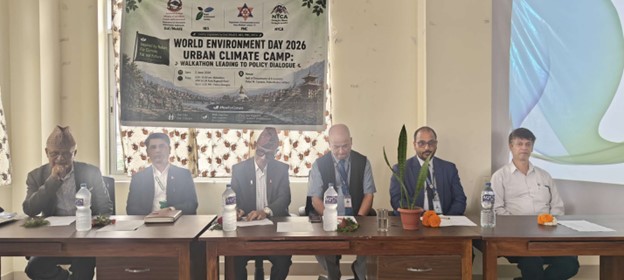
Fig: Chief guest, special guests, and organizers during the opening session
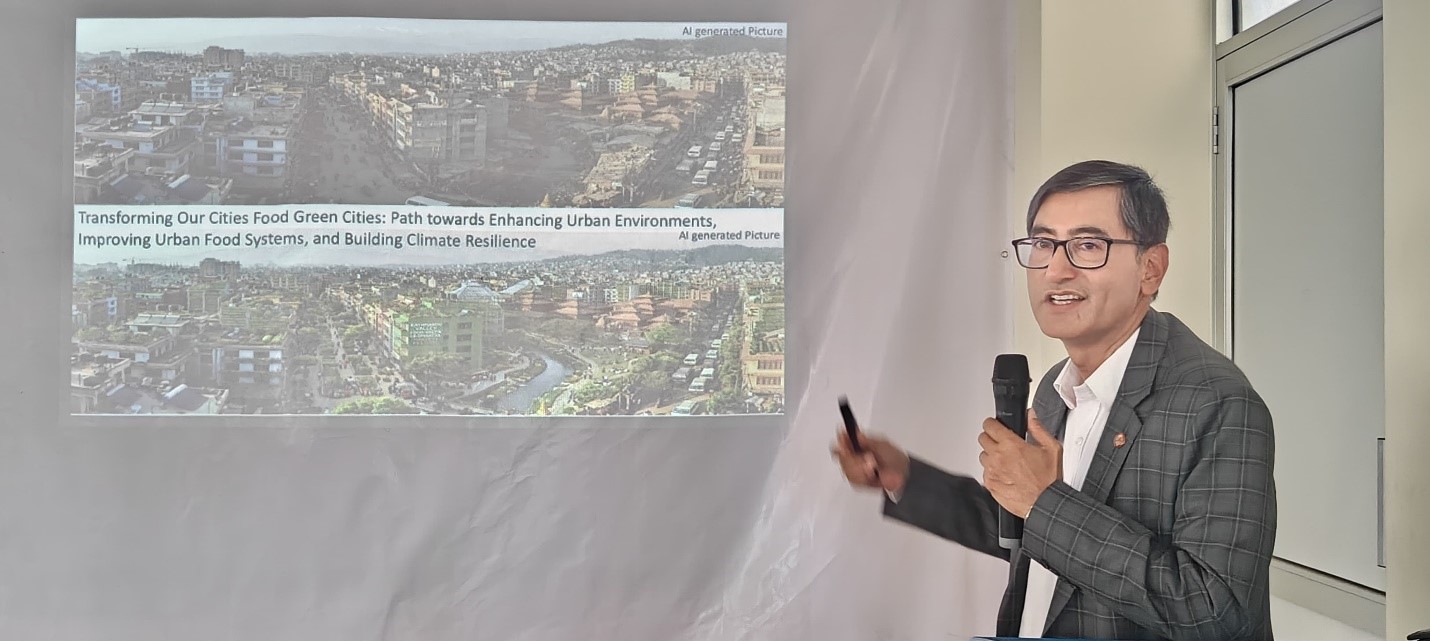
Fig: Dr. Sunil Babu Shrestha delivering the keynote presentation on Food Green Cities and Climate Resilience
Green Roof Technology for Urban Climate Adaptation: Dr. Binod Baniya, Chairperson of Nepal Environment Society and Assistant Professor at Tribhuvan University, delivered a technical presentation entitled “Modern Green Roof Technology: A Surrogate of Urban Greening to Combat Climate Extremes in Nepal.” The presentation discussed the potential of green roof technology in reducing urban heat stress, improving building energy efficiency, enhancing biodiversity, and strengthening urban climate resilience.
A panel discussion on “Urban Environment and Rivers for a Sustainable Future” brought together experts from the Water and Energy Commission Secretariat (WECS), Policy Research Institute (PRI), Patan Multiple Campus, NYCA, and other institutions. The discussion was chaired by Dr. Binod Baniya, Chairperson of Nepal Environment Society. Panelists discussed challenges associated with rapid urbanization, river degradation, climate change, environmental governance, and sustainable development. The discussion also emphasized the importance of strengthening environmental institutions, improving coordination mechanisms, establishing an effective Environment Council, and ensuring appropriate institutional recognition of environmental professionals within government structures.
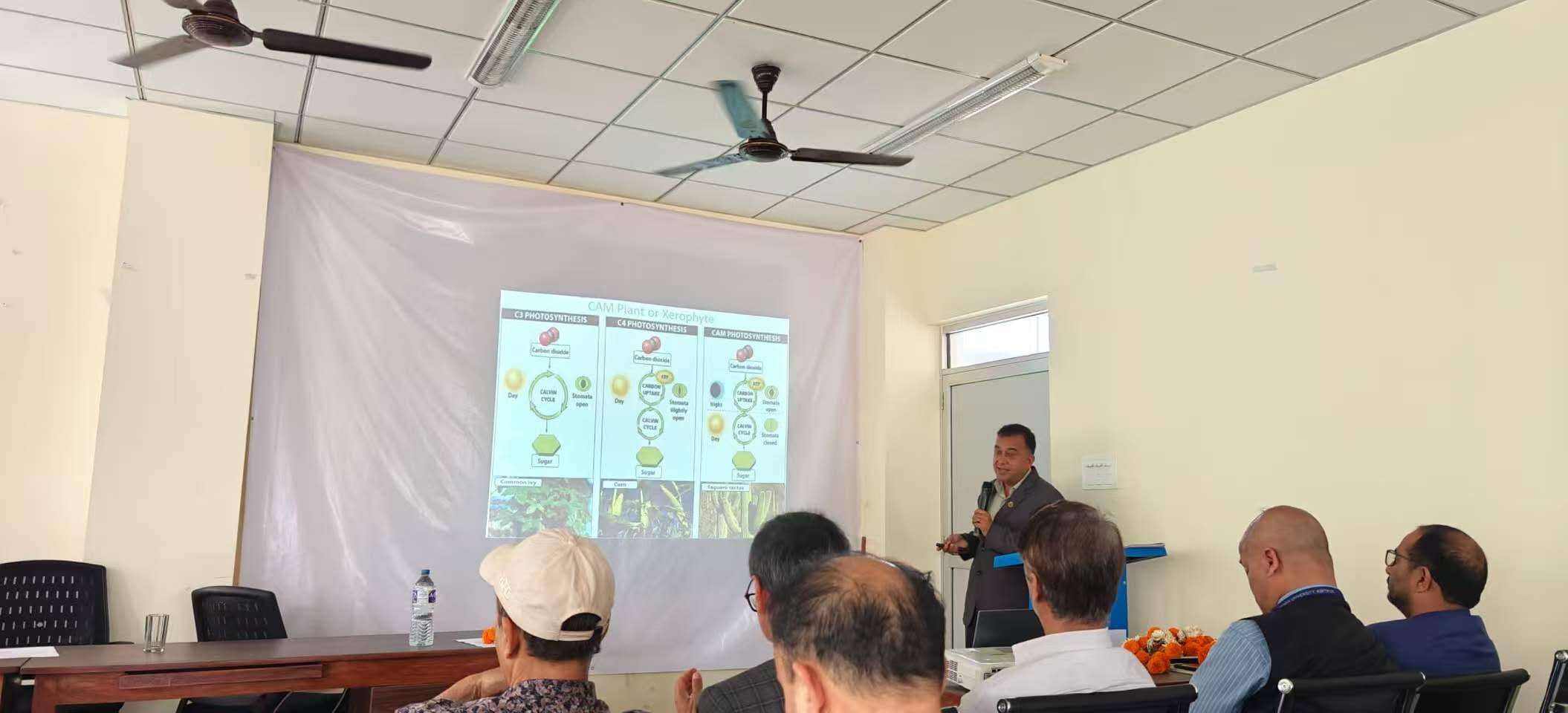
Fig: Dr. Binod Baniya presenting on modern green roof technology and urban climate adaptation
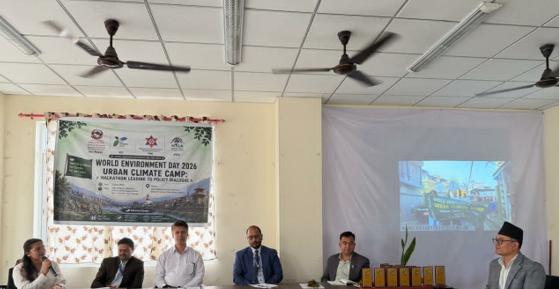
Fig: Panel discussion on urban environment, rivers, climate change, and sustainable development.
he program concluded with the recognition of NES lifetime members with their certificate distribution and awards for outstanding art, poster, speech, and video presentations produced as part of the walkathon and environmental awareness activities. The formal launch of the NES upcoming scientific Journal name titled “NES journal of Environment” was also conducted with the hand of Founder Chairman of the NES Prof. Dr. Madan Koirala. The World Environment Day 2026 celebration successfully provided a platform for knowledge sharing, dialogue, and collaboration among policymakers, academics, environmental professionals, students, and youth leaders.
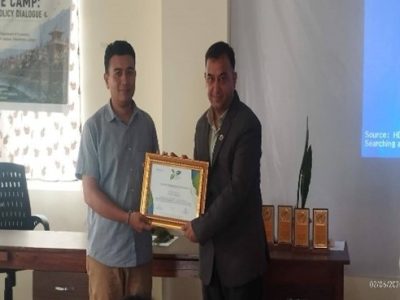
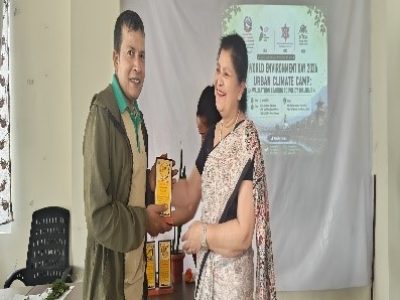
Fig: Inaugurated Journal name and recognition certificate of Lifetime member
Through the walkathon, technical presentations, panel discussions, and awareness activities, the event reinforced the importance of integrating science, policy, and community engagement to address climate change and urban environmental challenges in Nepal. The program concluded with recognition of participants and contributors and reaffirmed a collective commitment toward building greener, healthier, more resilient, and sustainable cities for future generations. During World Environment Week, Nepal Environment Society members also actively participated in several programs organized by government agencies, universities, and non-governmental organizations, further demonstrating their dedication to environmental conservation and climate resilience.